Anyone designing across chemistries meets an apparent oddity: lithium-ion cells are charged with a constant-current then constant-voltage taper that holds a precise maximum voltage, while NiMH chargers regulate current and instead watch for a voltage peak and fall. The difference is not convention - it follows from how each chemistry fails at high state of charge. This paper compares constant-current, constant-voltage and combined CC-CV regimes, explains why a voltage clamp cannot 'top off' a NiMH cell the way it does a lithium cell, clarifies what the often-quoted 1.5 V per-cell ceiling really represents, and draws the design implications for multi-chemistry chargers and for engineers transferring lithium habits into nickel systems.
Constant current (CC) holds a fixed current while voltage finds its own level; constant voltage (CV) holds a fixed voltage while current decays as the cell approaches it; CC-CV applies CC until a voltage threshold, then CV while current tapers to a termination value. Lithium-ion uses CC-CV because its binding constraint is an upper intercalation voltage beyond which plating and cathode damage occur: holding that voltage lets the last capacity be added at ever-decreasing, safe current.
The regime choice is dictated by what limits charging at high state of charge - a hard voltage potential in lithium, versus gas evolution and recombination in NiMH, which a voltage clamp does not control.
A NiMH cell at end of charge has no stable 'full' voltage to clamp: voltage depends on current, temperature, internal resistance and age, peaks, and then declines as recombination heating takes over (Paper 5). Holding a fixed voltage would therefore deliver an uncontrolled and temperature-dependent current - high into a cold, low-resistance cell and vanishing into a warm one - and would neither guarantee full charge nor limit overcharge, because the damaging process, oxygen recombination, proceeds at whatever current the clamp permits.
Worse, as the cell warms and its voltage falls at full charge, a CV source would increase current to hold voltage - positive feedback that drives more recombination, more heat and still lower voltage, the opposite of a safe taper. NiMH consequently requires current as the controlled variable and state-derived criteria as the stop signal.
Consumer charger literature sometimes describes bulk charging to about 1.45 V per cell and a maximum near 1.5 V; these are not CV setpoints but protective voltage bounds and stage-transition markers under the prevailing current. The number moves with rate and temperature - a 1C cold cell legitimately exceeds the voltage of a C/2 warm cell - so it is used as a fault ceiling (a cell above it at modest current is suspect) and as a multi-stage transition cue, never as a voltage at which current is tapered to completion.
Treating 1.5 V as a lithium-style CV target is a classic cross-chemistry error that undercharges warm cells and overcharges cold ones; the correct NiMH analogue of 'completion' is the conjunction of termination criteria, not a voltage.
Because current is the controlled quantity, the NiMH power stage is designed as a regulated current source - a buck with current-mode control, a current-limited linear regulator or a PWM-controlled switch with current sense - whose setpoint the state machine commands through fast, top-off and trickle levels. Voltage is measured but used for qualification, fault detection and termination inference, closing no voltage loop.
This is why NiMH charge ICs (the bq2002 family and its peers) expose current-control and timing pins rather than precision voltage-regulation loops: their control problem is sequencing current and detecting termination, which is fundamentally different from a lithium charge IC's precision-voltage task.
A charger supporting both lithium and NiMH must change control topology by mode: a voltage-regulated CC-CV loop with tight cell-voltage accuracy for lithium, and a current-regulated loop with -delta-V/dT/dt/timer termination for NiMH, with mode selected by user or reliable chemistry detection - never inferred from voltage alone, since a partially charged NiMH string can sit near lithium-like voltages. Cross-chemistry confusion is a genuine safety issue because each regime is unsafe for the other chemistry.
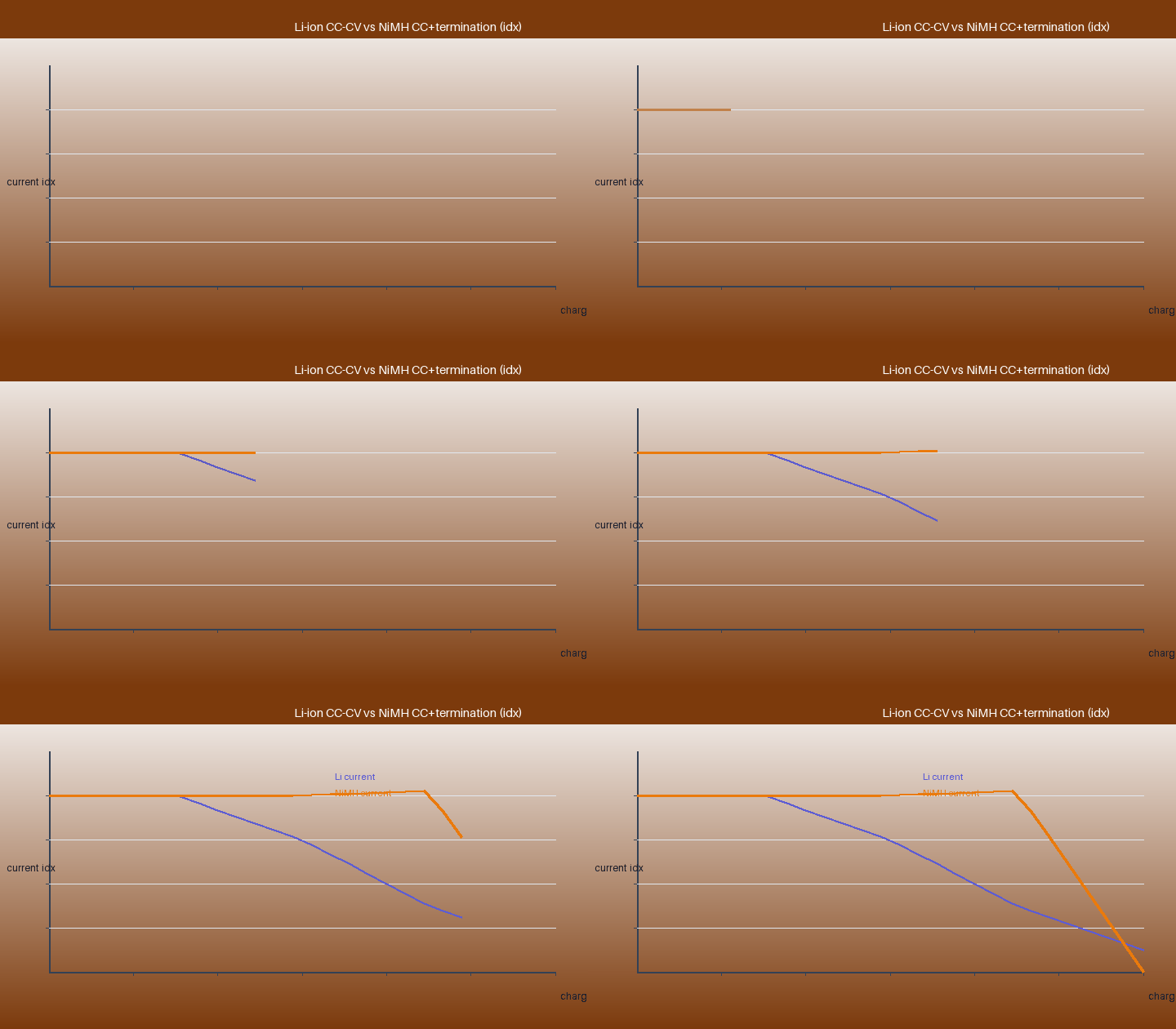
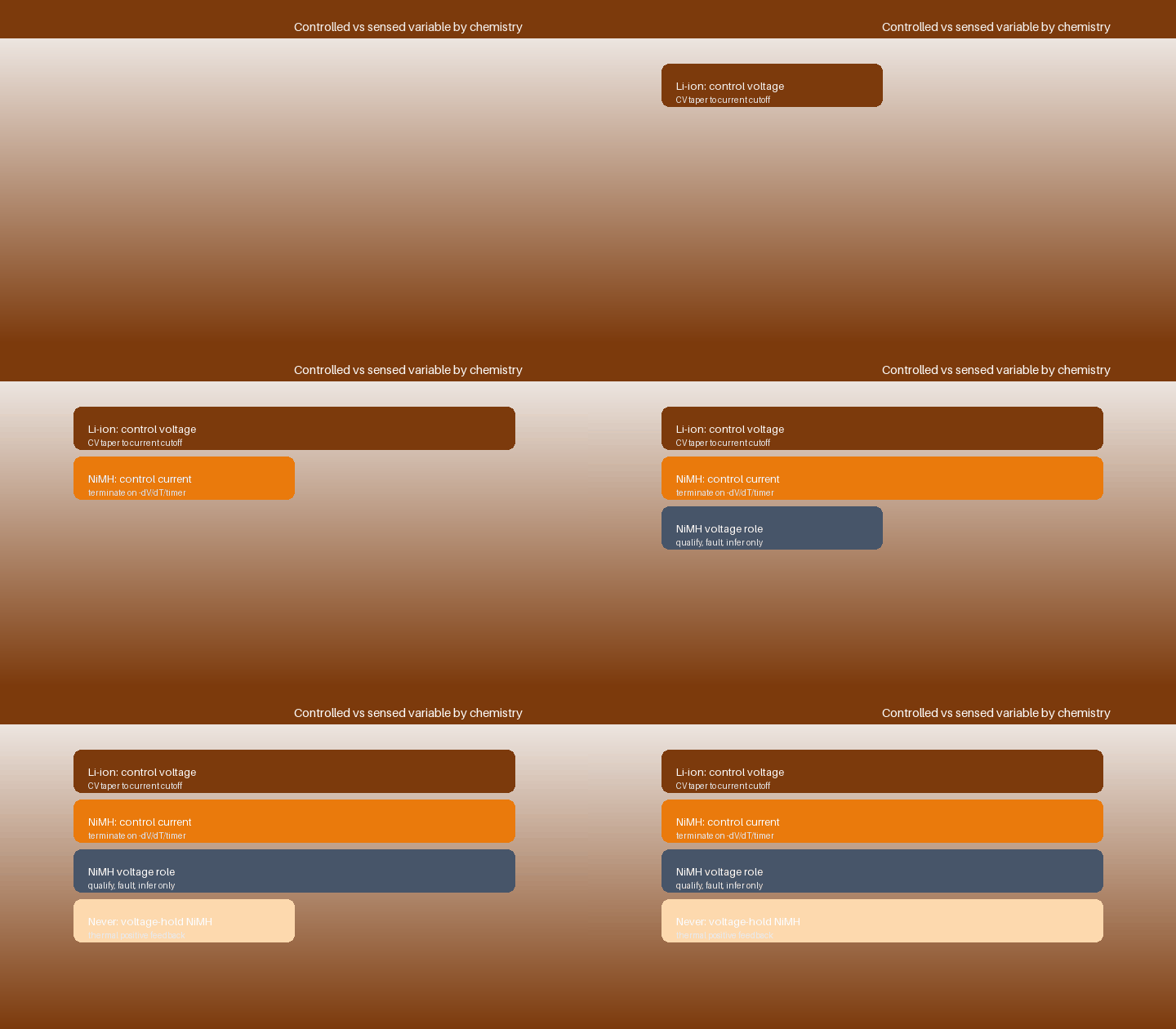
The first figure contrasts the current and voltage trajectories of lithium CC-CV with NiMH CC-plus-termination; the second maps which variable is controlled and which signals completion in each regime, making the inversion explicit.
For NiMH, specify a current-controlled stage, define current levels by regime, use voltage only for qualification/fault/termination, and never implement a voltage-hold taper; for multi-chemistry products, isolate the two control loops and make chemistry selection unambiguous and fail-safe. Validate NiMH profiles across temperature to show completion is reached by termination criteria rather than voltage, and confirm no control path can increase current into a warming full cell.
Weijiang supplies current-voltage-temperature charge surfaces for its cells so the current-controlled profile and its protective voltage bounds reflect measured behaviour. With the fast-charge techniques and regimes established, the series turns next to the problem of knowing what is happening inside the cell during charge - state-of-charge and state-of-health estimation.
Weijiang Power designs and manufactures nickel-metal hydride cells, matched packs and charging-ready configurations for consumer, industrial, medical and mobility customers, and supports partners with charge-protocol guidance, IEC 61951-2 performance files, IEC 62133-1 safety evidence and charger co-validation. Share your cell format, charge rate, thermal envelope and cycle target and our engineers will specify a cell-and-charge combination that protects both runtime and service life. Review the range on the products page.


