Aug.2026 27
意見: 364
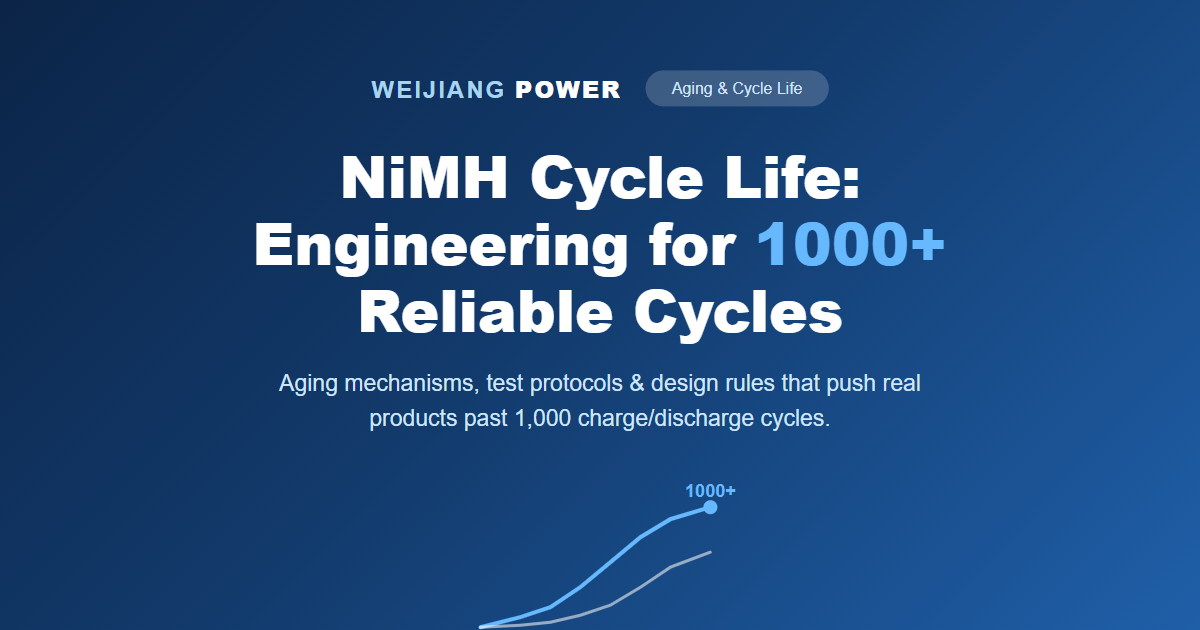
NiMH Aging & Cycle Life: Engineering for 1000+ Reliable Cycles
介紹
"Cycle life" is the number of charge/discharge cycles a cell survives before capacity drops below a threshold (commonly 80%).
細節

Intro

"Cycle life" is the number of charge/discharge cycles a cell survives before capacity drops below a threshold (commonly 80%). For NiMH, typical rated life is 500–1000 cycles, but actual service life depends heavily on depth of discharge, temperature, charge protocol and current. This article explains the aging mechanisms and the design rules that push real products past 1000 cycles.

Body

1. How NiMH ages

Two dominant degradation modes:

  • Capacity fade: from electrode pulverization, particle disconnection, and electrolyte decomposition.
  • Internal resistance rise: from surface oxidation, separator drying, and current-collector corrosion.

Both raise voltage drop and lower usable energy over time.

2. Accelerating factors (what kills cells early)

  • Deep discharge below ~0.9V/cell — causes electrolyte breakdown and cell reversal in series packs.
  • Overcharge — gas generation and heat accelerate all fade mechanisms.
  • High temperature — every +10°C roughly halves lifetime.
  • High-rate stress on poorly designed cells.
  • Storage at full charge + heat — fastest calendar-aging combination.

3. How cycle life is tested

Standard protocol: charge at 0.1–0.2C, rest, discharge at 0.2C to cutoff, repeat at 20–25°C; end-of-life at 80% of rated capacity. Real-world testing should also run representative duty cycles (partial discharge, elevated temperature) for accuracy.

4. Engineering rules to reach 1000+ cycles

  • Keep depth of discharge ≤80% for demanding applications.
  • Use ΔV/ΔT charge termination to prevent overcharge.
  • Design thermal management to stay <40°C in normal use, <50°C max.
  • Avoid storage at full charge: ~50–60% SOC at cool temperature is ideal.
  • Cell matching (capacity + Ri) prevents pack imbalance that over-discharges weak cells.
  • Optimize separator & electrolyte for the specific duty (LSD, high-rate, or wide-temp variants).

5. Balancing cycle life vs cost

Longer-life cells cost more up front but lower total cost of ownership. For high-usage devices (tools, medical), a 1000-cycle cell can outlast the product lifetime; for low-use devices, a 500-cycle LSD cell is often the economical choice.

Conclusion

1000+ cycles is achievable with disciplined charge control, thermal design, and correct cell selection — not by luck. Match the cell chemistry variant to the duty cycle, respect the operating envelope, and NiMH will deliver years of reliable service. Weijiang documents cycle-life curves for every cell and can engineer custom packs for extended-life applications.

Lastest News
Unlock the power of lithium batteries for lasting performance in handheld vacuum cleaners. Weijiang Li-on Battery leads the charge in innovation.
更多
A NiMH battery pack is a collection of individual NiMH batteries connected in series or parallel to create a higher voltage or capacity battery.
更多
REQUEST MORE DETAILS
Please fill out the form below and click the button to request more information about
Name*
Whatsapp/電話*
電子郵件
訊息
專業電池工廠,支援 OEM 與 ODM 客製。
REQUEST MORE DETAILS
Please fill out the form below and click the button to request more information about
Company Name*
電子郵件地址*
WhatsApp / 電話*
訊息與需求*