A remote pressure or flow monitor bolted to a buried or above-ground pipeline has to run for years on its own battery while sampling a powered transducer and reporting over NB-IoT or LoRa. Its load profile is a study in contrast: a sleep current measured in tens of microamperes, a pressure-transducer excitation of several milliamperes for about a second per sample, a cellular burst averaging tens of milliamperes for a couple of seconds with peaks above a hundred milliamperes, and - when a pressure transient or water-hammer event strikes - a short, intense high-rate sampling burst. This paper unpacks that profile and the role of a rechargeable nickel-metal hydride buffer, especially in solar-assisted terminals.
A modern monitoring terminal pairs a pressure (and sometimes flow or level) transducer with a low-power MCU, logger and cellular or LPWAN radio, sealed to IP66-IP68 per IEC 60529 and rated for a wide field temperature - datasheets commonly span -30 to +70 C. It logs a pressure profile on a schedule (hourly is typical), raises alarms on threshold or rate-of-change events, and uploads by NB-IoT, LTE-M or LoRaWAN. Commercial examples illustrate the power envelope: an NB-IoT pressure logger using three replaceable AA cells of a few ampere-hours claims up to five years, and LoRa variants with larger packs extend further.
Unlike a legal billing meter, this is industrial monitoring equipment, governed more by EMC (the IEC 61000 series), ingress and the cellular carrier's radio requirements than by metrology law - but its battery discipline is just as severe.
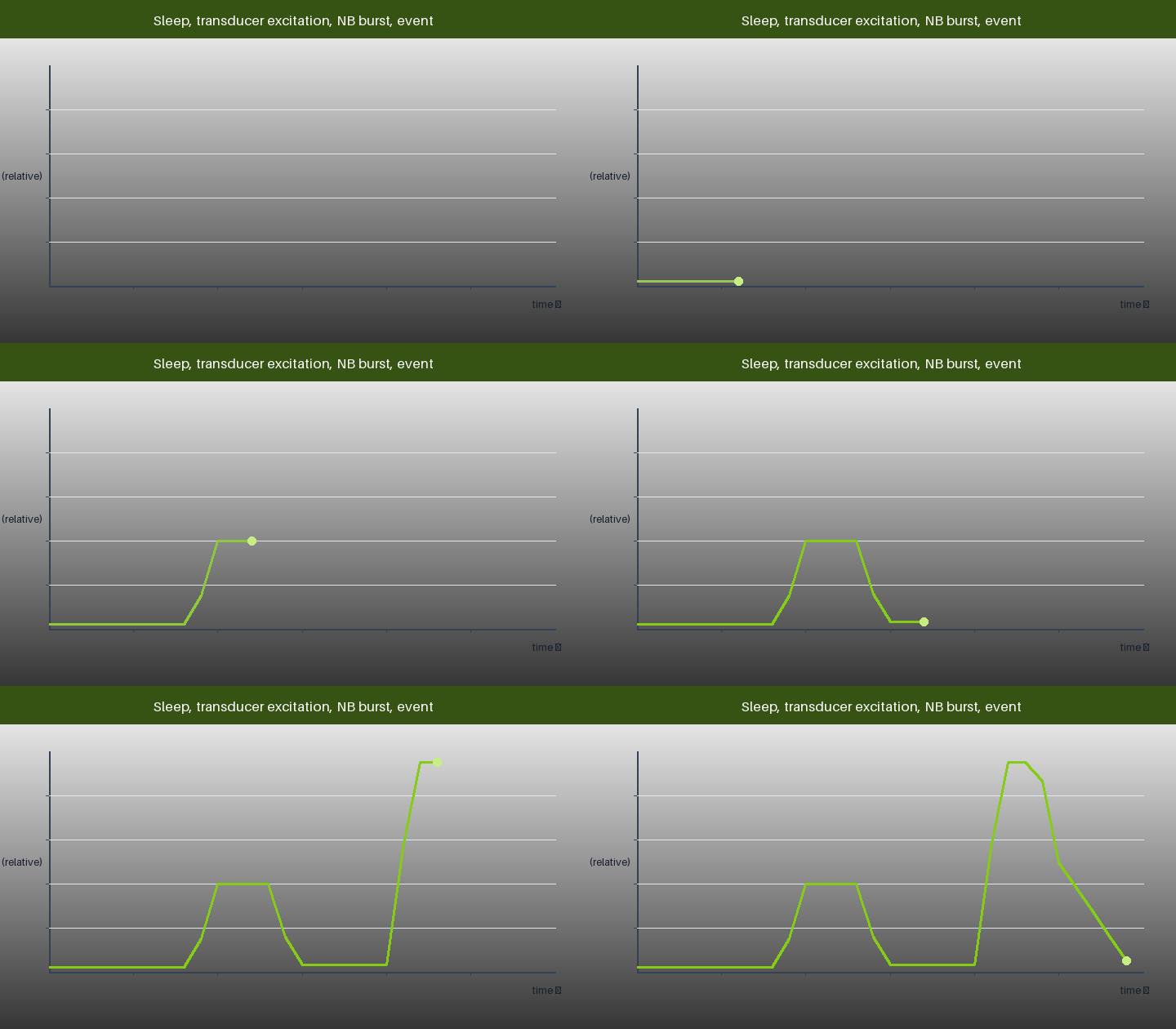
The first animated figure traces the current across time. Sleep dominates at under a few tens of microamps (the best designs approach a microamp). At each sample the transducer is excited - a piezoresistive or ceramic sensor needs several milliamperes for stabilisation, roughly a second - while the ADC takes a reading. On the report schedule the radio attaches and sends, with NB-IoT averaging on the order of 35 mA for a couple of seconds in a compact transmission or up to around 15 mA for 90 seconds in a heavier online session, peaking at 100-200 mA.
The wildcard is the event: a water-hammer or pump trip triggers rapid high-rate sampling for seconds, which is both a processing and a current spike. A power source that cannot deliver that burst cleanly will miss the transient the terminal was installed to catch.
The second figure shows the now-familiar but decisive relationship: with fixed stored energy, field life collapses as the interval moves from daily to hourly to near-continuous, because every report carries a fixed cellular attach energy and every sample carries a transducer excitation. Vendor ratings from two to ten years are not inconsistent - they sit at different points on this surface, and the high-frequency end is where a primary-battery-only design runs out within a year or two.
This is precisely where a rechargeable architecture changes the economics: pairing a small solar panel with a rechargeable buffer lets the terminal sample and report as often as the network needs without a primary-cell life penalty.
The default for a buried, no-light location is a 3.6 V primary lithium pack of 8.5-19 Ah, chosen for energy density, with the same pulse-reservoir problem as smart meters: the primary cell is energy-rich but pulse-weak and passivates, so the radio and event bursts benefit from a low-impedance reservoir. For above-ground chambers, meter pits with light access, or rooftop/pipe-bridge mounts, a small photovoltaic panel plus a rechargeable buffer becomes attractive and can support much higher sampling rates indefinitely.
Sealed NiMH is an excellent rechargeable buffer here: it accepts the panel's irregular charge, delivers the transducer-stabilisation, radio and event bursts from a flat low-impedance plateau, cycles daily for years, discharges reliably in a cold winter pit, and uses an aqueous chemistry that is safe in a sealed, unattended enclosure.

Pressure-transient and leakage-detection algorithms need a burst of fast samples when something changes, and the radio may need to send an alarm immediately rather than waiting for the scheduled upload. That simultaneous high-rate sampling plus transmission is the worst-case current pulse, and it is non-negotiable: a buffer sized only for the routine hourly report will sag or reset on the one event that justifies the instrument.
NiMH's low internal resistance and high pulse capability, relative to its size, let a modest pack cover routine reports and transient alarms alike, while a supercapacitor would be bulky for the seconds-long combined load and a primary lithium cell would see its voltage collapse under the peak.
The design brief records the sleep current, transducer excitation current and time, sampling and reporting intervals, the radio technology with attach and peak currents, the worst-case event burst, the available solar energy (if any), the ingress rating and the -30 to +70 C temperature span. Paper B turns these into an energy budget and a primary-versus-rechargeable decision; Paper C maps the design onto ingress, EMC and the cell-level evidence.
Weijiang Power builds sealed nickel-metal hydride cells and solar-compatible buffer packs for NB-IoT and LoRa pressure and flow monitoring terminals. Share your transducer excitation current, sampling and reporting interval, radio profile, solar-panel size and temperature range, and our engineers will design a welded, cold-capable NiMH buffer or replaceable pack with charge management and protection. See formats on the products page.


